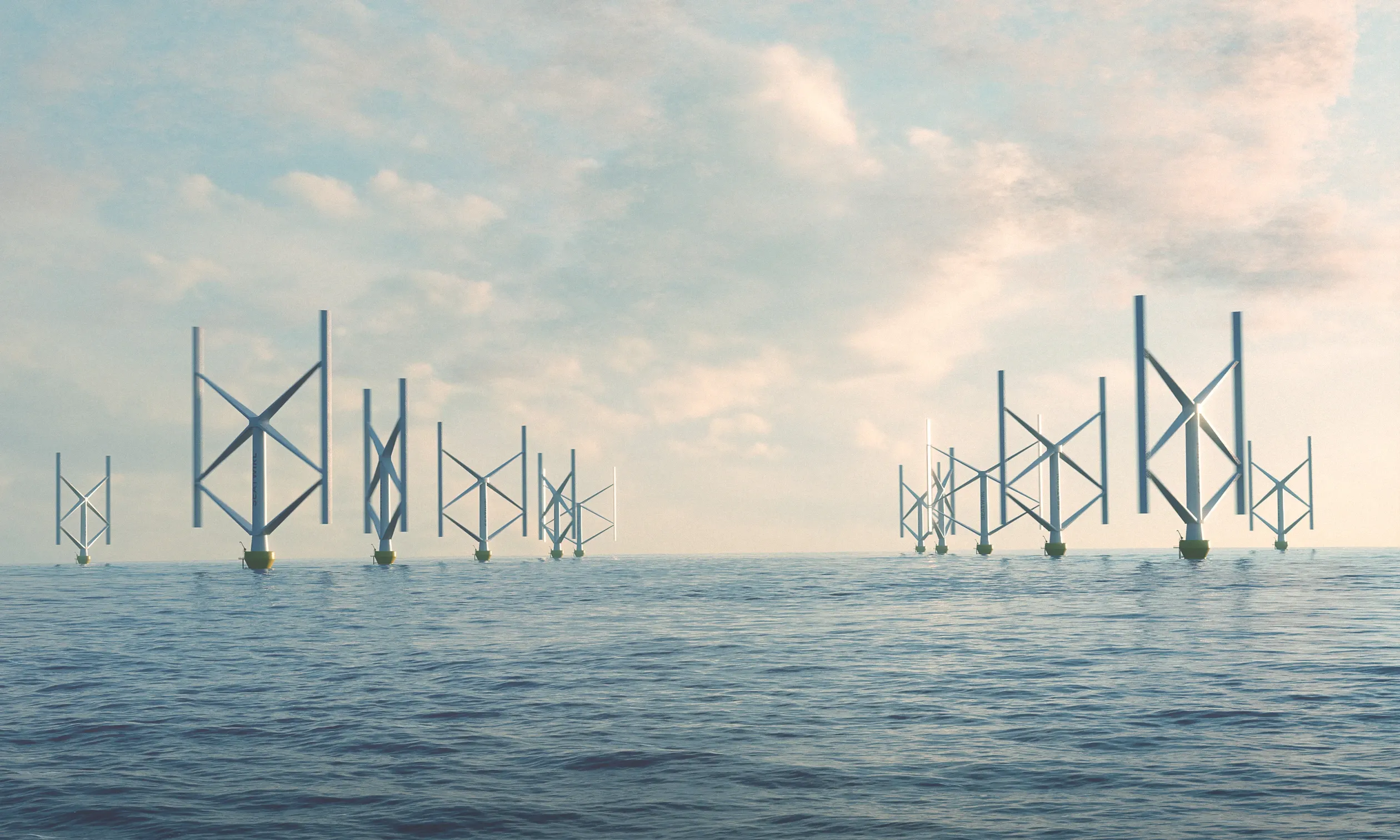
Sited far from shore
Less impact on the coastal environment, bird life and commercial fishing – and access to stronger, steadier winds.
01Invest in SeaTwirl
The energy transition requires deep-water offshore wind power – and SeaTwirl’s floating vertical-axis wind turbine is built for exactly that. Here we gather the whole investment case: what the company does, why the market is attractive and what the risks are.
02The company in brief
SeaTwirl develops floating vertical-axis wind turbines for deep water. The company is in the development phase. The 30 kW S1 prototype was installed in the sea off Lysekil from 2015 and was dismantled in November 2025 after ten years of operation. The next step is Verti-Go, a consortium of eleven partners that is to develop, manufacture, install and commission a 2 MW turbine. Horizon Europe is funding the project with EUR 15 million, and it runs until the end of 2029. At the same time, SeaTwirl is working with partners on local manufacturing in the markets the company is targeting.
03The market
Large parts of the world’s offshore wind resources are in water deeper than 60 metres, where bottom-fixed foundations are not economically viable. The build-out plans of Europe, Asia and North America all require floating technology.
300 GW
offshore wind power in 2050
15 GW
build-out rate per year
2 MW
Verti-Go’s demonstration turbine
SeaTwirl’s target segments are markets where the need for electricity is large and the alternatives expensive:
Source: SeaTwirl’s year-end report for 2025, which reproduces the Hamburg Declaration – signed on 26 January 2026 by nine heads of state from the countries around the North Sea. The declaration also states a combined investment of EUR 1,000 billion.
04Reasons to invest
The value drivers are found at three levels: macro (the energy transition and electrification), industry (a growing market where floating technology is required in deep water) and company (a technology with structural cost advantages):
Less impact on the coastal environment, bird life and commercial fishing – and access to stronger, steadier winds.
The vertical turbine works independently of wind direction, which eliminates the yaw system – a common source of faults.
The generator and drivetrain sit low and are easy to reach, which improves availability and lowers costs.
The turbine and the floating foundation are one unit – the complicated interface between turbine supplier and foundation supplier disappears.
Cuts production and maintenance costs and makes local manufacturing close to the market possible.
Stable renewable electricity supply for islands, fish farms and offshore installations that today run on diesel.
The patent portfolio consists of six families with priority dates spanning thirteen years, from 2009 to 2022, and the youngest is still under examination. The four oldest are those of the founder, Daniel Ehrnberg. The fifth has Martin Rosander as its inventor, the sixth Jonas Boström and Erik Aronsson – the company’s own employees. All the families stand in the name of SeaTwirl AB, and nothing in the portfolio is owned personally.
The protection is concentrated rather than spread thin. Two families are granted in Europe, the United States, Japan and China: the patent on the divisible wind turbine, which is the most broadly maintained of the older ones, and the most recently granted – the one that comes out of the company’s own organisation. The company therefore spends most on its newest work and maintains the older families where they matter most. That is a choice, and the company pays for it.
05Milestones
Daniel Ehrnberg tests the first prototype with good results.
The company is formed on 23 February 2012 and raises its first capital.
The 30 kW prototype is commissioned off Lysekil and connected to the electricity grid.
The share is admitted to trading on 22 December 2016 under the ticker STW, following a share issue of 24 MSEK.
The Japan Patent Office approves the patent on a divisible wind turbine, which by then had already been granted in Sweden, the United States, China and Europe.
The Norwegian licence enters into legal force, Johan Sandberg takes office as CEO and SeaTwirl signs a letter of intent with Oceaneering.
Horizon Europe funds the Verti-Go consortium with EUR 15 million. The two-bladed turbine is presented in May, and S1 is dismantled in November after ten years of operation.
Strategic partnership agreement with Mooreast Asia for floating offshore wind in South-East Asia.
The project is to take the turbine all the way from design to operation at sea, and is the full-scale demonstration on which the company’s commercialisation rests.
06Risk
SeaTwirl is a development company. The company has not yet launched a commercial wind turbine, neither on its own nor through a partner, and there are therefore no sales on which to assess it. The technology is verified at sea on a small scale – the 30 kW S1 prototype stood off Lysekil for ten years – and the next step is to demonstrate a 2 MW turbine within Verti-Go, up to the end of 2029. An investment in the share therefore carries a high level of risk.
The risks are managed in a single consolidated risk list covering the seven areas below. The CEO owns the list, and each area has a named owner in management who assesses likelihood and consequence and answers for what is done about the risk. Management goes through the list every quarter in connection with the interim report, and the board of directors deals with it as a standing item four times a year and adopts it in its entirety once a year.
The step from a verified 30 kW prototype to a 2 MW turbine remains, and the technology is not yet settled: in May 2025 the company made a thoroughgoing adjustment to the technical concept and moved to a rotor with two blades. That a full-scale demonstration succeeds is not a given.
Harsh marine environments place high demands on operation and maintenance, which according to the company’s own description of Verti-Go often account for 50–80 per cent of total operating costs. The operating environment also includes the dynamic cable, which has to carry its own weight and withstand the turbine’s movements in the water.
Manufacturing capacity for platforms, mooring systems and specialised installation vessels is limited across the whole industry. SeaTwirl is also to reach the market together with others: Verti-Go is run by eleven partners, and manufacturing close to the market rests on local partnerships such as the one with Mooreast Asia.
Offshore wind power requires permits, and they take time and can be appealed. The Norwegian licence in Bokn was granted in March 2022, was appealed, and did not enter into legal force until January 2023, when the appeal was rejected. Timetables that rest on permits are therefore uncertain.
Part of the value in the technology lies in patents. The portfolio comprises six families, and the 2025 balance sheet carries patents at 1,582,804 SEK. Patent protection applies market by market, has to be maintained with annual fees in order to remain in force, and can be challenged. Protection carried by few families also makes the outcome of a single case more keenly felt.
The company is small: the average number of employees was 14 during 2025. Individual departures are therefore noticeable, and a replacement takes time to find.
Without sales, earnings capacity cannot be assessed, and larger revenues may fail to materialise in whole or in part. The board of directors’ assessment in the 2025 annual report is that the business plan for 2026 can be financed with available funds. What covers the capital requirement after that is not settled, and depends on the revenues, grants and share issues the company brings about.
The compilation is an overview. The complete risk section is set out in the 2025 annual report and in the most recent prospectus.